Board Reporting for M&A

Effective board reporting for M&A builds trust, ensures oversight, leverages board expertise, and secures support for transactions. Well-structured quarterly updates and deal-specific presentations keep directors informed and engaged without overwhelming them.

Board M&A Update Presentation Flow - Visual showing the quarterly board update structure with sections for Strategy, Pipeline, Recent Deals, Market Intelligence, and Requests


Why Board Reporting Matters

Why Board Reporting Matters - Visual Overview

Board's Role in M&A:

  • Oversight: Ensure M&A aligns with corporate strategy and creates value
  • Approval: Authorize transactions above materiality threshold
  • Guidance: Provide strategic counsel and leverage networks
  • Risk Management: Challenge assumptions and mitigate risks

What Boards Want:

  • βœ… Transparent pipeline visibility (without confidential details)
  • βœ… Confidence M&A strategy is deliberate, not opportunistic
  • βœ… Evidence deals create value (post-close tracking)
  • βœ… Early warning of issues, not surprises
  • βœ… Clear asks and decisions needed

What Boards Don't Want:

  • ❌ Surprises (deal announcements with no prior context)
  • ❌ Vague strategy ("we're looking at stuff")
  • ❌ Promises without accountability (synergies never tracked)
  • ❌ Endless detail on deals that won't happen
  • ❌ Requests for approval without adequate preparation

Board Reporting Framework

Three Types of Board Engagement

β”Œβ”€β”€β”€β”€β”€β”€β”€β”€β”€β”€β”€β”€β”€β”€β”€β”€β”€β”€β”€β”€β”€β”€β”€β”€β”€β”€β”€β”€β”€β”€β”€β”€β”€β”€β”€β”€β”€β”€β”€β”€β”€β”€β”€β”€β”€β”€β”€β”€β”€β”€β”€β”€β”
β”‚     1. QUARTERLY UPDATES                            β”‚
β”‚  Regular cadence, strategic focus, pipeline view   β”‚
β”‚  (30-60 min, part of regular board meeting)        β”‚
β””β”€β”€β”€β”€β”€β”€β”€β”€β”€β”€β”€β”€β”€β”€β”€β”€β”€β”€β”€β”€β”€β”€β”€β”€β”€β”€β”€β”€β”€β”€β”€β”€β”€β”€β”€β”€β”€β”€β”€β”€β”€β”€β”€β”€β”€β”€β”€β”€β”€β”€β”€β”€β”˜

β”Œβ”€β”€β”€β”€β”€β”€β”€β”€β”€β”€β”€β”€β”€β”€β”€β”€β”€β”€β”€β”€β”€β”€β”€β”€β”€β”€β”€β”€β”€β”€β”€β”€β”€β”€β”€β”€β”€β”€β”€β”€β”€β”€β”€β”€β”€β”€β”€β”€β”€β”€β”€β”€β”
β”‚     2. DEAL-SPECIFIC APPROVALS                      β”‚
β”‚  For transactions above board threshold             β”‚
β”‚  (60-90 min, special session or board meeting)     β”‚
β””β”€β”€β”€β”€β”€β”€β”€β”€β”€β”€β”€β”€β”€β”€β”€β”€β”€β”€β”€β”€β”€β”€β”€β”€β”€β”€β”€β”€β”€β”€β”€β”€β”€β”€β”€β”€β”€β”€β”€β”€β”€β”€β”€β”€β”€β”€β”€β”€β”€β”€β”€β”€β”˜

β”Œβ”€β”€β”€β”€β”€β”€β”€β”€β”€β”€β”€β”€β”€β”€β”€β”€β”€β”€β”€β”€β”€β”€β”€β”€β”€β”€β”€β”€β”€β”€β”€β”€β”€β”€β”€β”€β”€β”€β”€β”€β”€β”€β”€β”€β”€β”€β”€β”€β”€β”€β”€β”€β”
β”‚     3. AD HOC UPDATES                               β”‚
β”‚  Material developments, competitive situations      β”‚
β”‚  (Email or call between meetings)                  β”‚
β””β”€β”€β”€β”€β”€β”€β”€β”€β”€β”€β”€β”€β”€β”€β”€β”€β”€β”€β”€β”€β”€β”€β”€β”€β”€β”€β”€β”€β”€β”€β”€β”€β”€β”€β”€β”€β”€β”€β”€β”€β”€β”€β”€β”€β”€β”€β”€β”€β”€β”€β”€β”€β”˜

Quarterly Board Updates

Frequency: Every board meeting (typically quarterly)

Duration: 30-60 minutes

Audience: Full board or M&A committee

Purpose: Strategic transparency, pipeline overview, performance tracking

Quarterly Update Structure

Agenda (30-60 min):

  1. M&A Strategy Refresh (5-10 min)
  2. Pipeline Overview (10-15 min)
  3. Recent Transactions & Integration (10-15 min)
  4. Market Intelligence (5-10 min)
  5. Q&A (10-15 min)

Slide 1: M&A Strategy Refresh

Purpose: Remind board how M&A supports corporate strategy

M&A STRATEGIC PRIORITIES - [Year]

CORPORATE OBJECTIVES β†’ M&A FOCUS AREAS

1. Accelerate cloud transition
   β†’ Acquire cloud-native SaaS companies ($50-200M)

2. Expand enterprise customer base
   β†’ Target companies serving Fortune 500 with high NRR

3. Build AI/ML capabilities
   β†’ Acquire AI technology and talent ($20-100M)

4. Geographic expansion (Europe)
   β†’ Explore European market leaders in core verticals

CAPITAL ALLOCATION:
β€’ M&A Budget: $400-800M for [Year]
β€’ Deal Size Range: $25-250M per transaction
β€’ Target: 3-5 deals annually

Key Message: M&A is strategic and aligned with board-approved priorities, not random opportunism

Slide 2: Pipeline Overview

Purpose: Provide transparency into deal flow without breaching confidentiality

Balance: Show enough for visibility, not so much you compromise live negotiations

PIPELINE OVERVIEW - [Quarter]

PIPELINE SUMMARY:
β€’ Active Opportunities: 15 deals ($1.2B total value)
β€’ New This Quarter: 8 deals added
β€’ Advanced: 5 deals moved to next stage
β€’ Exited: 4 deals killed

PIPELINE BY STAGE:
β”Œβ”€β”€β”€β”€β”€β”€β”€β”€β”€β”€β”€β”€β”€β”€β”€β”€β”€β”€β”€β”€β”€β”€β”€β”€β”€β”€β”€β”€β”€β”€β”€β”€β”€β”€β”€β”€β”
β”‚ Closing (1-2 deals)           [β–ˆβ–ˆ]β”‚  Expected close: Q4
β”‚ Diligence (2-3 deals)        [β–ˆβ–ˆβ–ˆβ–ˆ]β”‚  Active DD in progress
β”‚ LOI Stage (2-4 deals)       [β–ˆβ–ˆβ–ˆβ–ˆβ–ˆβ–ˆ]β”‚  Term sheet negotiations
β”‚ Active Pipeline (5-10)  [β–ˆβ–ˆβ–ˆβ–ˆβ–ˆβ–ˆβ–ˆβ–ˆβ–ˆβ–ˆβ–ˆ]β”‚  Mutual interest
β”‚ Early Stage (10-20)    [β–ˆβ–ˆβ–ˆβ–ˆβ–ˆβ–ˆβ–ˆβ–ˆβ–ˆβ–ˆβ–ˆ ]β”‚  Exploratory discussions
β””β”€β”€β”€β”€β”€β”€β”€β”€β”€β”€β”€β”€β”€β”€β”€β”€β”€β”€β”€β”€β”€β”€β”€β”€β”€β”€β”€β”€β”€β”€β”€β”€β”€β”€β”€β”€β”˜

NEAR-TERM PIPELINE:
β€’ Deal A (Cloud Security, $150-200M): In diligence, IC approved LOI
β€’ Deal B (AI Analytics, $50-75M): LOI negotiation, expect sign Nov
β€’ Deal C (SaaS, $100-150M): Active discussions, high strategic fit

NOTE: Specific company names withheld per confidentiality agreements.
Board will be notified when binding offers are submitted.

Best Practices:

  • Aggregate numbers, not individual target names (unless at LOI+ stage)
  • Show stage distribution (healthy pipeline has deals across all stages)
  • Highlight deals likely to need board approval soon
  • Be transparent about kills (shows discipline)

Slide 3-4: Recent Transactions & Integration

Purpose: Demonstrate value creation and accountability

RECENT TRANSACTIONS (Last 12 Months)

β”Œβ”€β”€β”€β”€β”€β”€β”€β”€β”€β”€β”€β”€β”€β”€β”€β”€β”€β”€β”€β”€β”€β”€β”€β”€β”€β”€β”€β”€β”€β”€β”€β”€β”€β”€β”€β”€β”€β”€β”€β”€β”€β”€β”€β”€β”€β”€β”€β”€β”€β”€β”€β”€β”€β”€β”
β”‚ CLOUDRE ACQUISITION - Closed Oct 2024               β”‚
β”œβ”€β”€β”€β”€β”€β”€β”€β”€β”€β”€β”€β”€β”€β”€β”€β”€β”€β”€β”€β”€β”€β”€β”€β”€β”€β”€β”€β”€β”€β”€β”€β”€β”€β”€β”€β”€β”€β”€β”€β”€β”€β”€β”€β”€β”€β”€β”€β”€β”€β”€β”€β”€β”€β”€β”€
β”‚ Deal Size: $200M (3.5x Revenue, 11.5x EBITDA)       β”‚
β”‚ Strategic Rationale: Cloud security platform        β”‚
β”‚                                                       β”‚
β”‚ Integration Status (30 days post-close):             β”‚
β”‚ β€’ Employee Retention: 98% (vs. 90% target) 🟒       β”‚
β”‚ β€’ Customer Retention: 99% (vs. 95% target) 🟒       β”‚
β”‚ β€’ Synergies: $3.2M captured (vs. $3.5M plan) 🟑     β”‚
β”‚ β€’ Milestones: 90% on-time 🟒                        β”‚
β”‚                                                       β”‚
β”‚ Year 1 Outlook: On track to deliver $14M synergies  β”‚
β””β”€β”€β”€β”€β”€β”€β”€β”€β”€β”€β”€β”€β”€β”€β”€β”€β”€β”€β”€β”€β”€β”€β”€β”€β”€β”€β”€β”€β”€β”€β”€β”€β”€β”€β”€β”€β”€β”€β”€β”€β”€β”€β”€β”€β”€β”€β”€β”€β”€β”€β”€β”€β”€β”€β”˜

β”Œβ”€β”€β”€β”€β”€β”€β”€β”€β”€β”€β”€β”€β”€β”€β”€β”€β”€β”€β”€β”€β”€β”€β”€β”€β”€β”€β”€β”€β”€β”€β”€β”€β”€β”€β”€β”€β”€β”€β”€β”€β”€β”€β”€β”€β”€β”€β”€β”€β”€β”€β”€β”€β”€β”€β”
β”‚ DATAANALYTICS ACQUISITION - Closed Jan 2024         β”‚
β”œβ”€β”€β”€β”€β”€β”€β”€β”€β”€β”€β”€β”€β”€β”€β”€β”€β”€β”€β”€β”€β”€β”€β”€β”€β”€β”€β”€β”€β”€β”€β”€β”€β”€β”€β”€β”€β”€β”€β”€β”€β”€β”€β”€β”€β”€β”€β”€β”€β”€β”€β”€β”€β”€β”€β”€
β”‚ Deal Size: $150M (4.2x ARR)                         β”‚
β”‚ Strategic Rationale: AI/ML analytics capabilities    β”‚
β”‚                                                       β”‚
β”‚ Performance (9 months post-close):                   β”‚
β”‚ β€’ Revenue vs. Plan: 103% 🟒                         β”‚
β”‚ β€’ EBITDA vs. Plan: 108% 🟒                          β”‚
β”‚ β€’ Synergies: $28M captured (vs. $30M Y1 plan) 🟑    β”‚
β”‚ β€’ Integration: 95% milestones complete 🟒           β”‚
β”‚                                                       β”‚
β”‚ Update: Exceeding plan, strong cross-sell traction  β”‚
β””β”€β”€β”€β”€β”€β”€β”€β”€β”€β”€β”€β”€β”€β”€β”€β”€β”€β”€β”€β”€β”€β”€β”€β”€β”€β”€β”€β”€β”€β”€β”€β”€β”€β”€β”€β”€β”€β”€β”€β”€β”€β”€β”€β”€β”€β”€β”€β”€β”€β”€β”€β”€β”€β”€β”˜

Portfolio Performance Summary:

Deal Vintage IRR (Underwrit) IRR (Actual) Synergy Capture Status
CloudSecure 2024 18.5% TBD (6mo) 88% 🟒 On Track
DataAnalytics 2024 22.1% 24.5% 93% 🟒 Exceeding
CyberTech 2023 16.8% 14.2% 75% 🟑 Below Plan
SaaSCo 2023 19.3% 21.8% 102% 🟒 Exceeding

Portfolio Avg: 18.8% underwriting β†’ 20.2% actual (24 mo avg) 🟒 Strong Performance

Key Message: We deliver on promised returns and track rigorously post-close

Slide 5: Market Intelligence

Purpose: Keep board informed on competitive landscape and valuation trends

MARKET INTELLIGENCE - [Quarter]

COMPETITIVE M&A ACTIVITY:
β€’ Competitor X acquired Y Corp for $300M (8.5x EBITDA)
  β†’ Strategic rationale: European expansion
  β†’ Implication: Validates our Europe strategy, may increase valuations

β€’ Competitor Z acquired AI Startup for $120M
  β†’ Strategic rationale: AI capabilities similar to our priority
  β†’ Implication: Competitive pressure to move faster on AI M&A

VALUATION TRENDS:
β€’ SaaS multiples: 4.2x ARR (down 15% from Q2 peak)
β€’ Cybersecurity: 10.5x EBITDA median
β€’ AI/ML: 5-7x ARR for growth companies
β†’ Observation: More favorable buying environment than 12 months ago

MARKET OPPORTUNITIES:
β€’ 3 high-quality targets in cloud security likely to come to market Q4-Q1
β€’ PE firm X exploring exit of portfolio company (strong fit with our priorities)
β€’ Distressed opportunities emerging in over-leveraged VC-backed companies

Key Message: We're monitoring the landscape and have good market intelligence

Slide 6: Requests for Board

Purpose: Leverage board expertise and networks

REQUESTS FOR BOARD GUIDANCE

STRATEGIC QUESTIONS:
1. Europe Expansion: Should we prioritize European M&A or organic growth?
   β†’ Board feedback on market entry strategy and timing

2. Deal Size: Comfort with larger transformational deal ($400-500M)?
   β†’ One large platform vs. multiple bolt-ons

NETWORK LEVERAGE:
3. Target Access: [Board Member A], can you introduce us to [Company X]?
   β†’ Company X CEO is in your network per LinkedIn

4. Market Intelligence: [Board Member B], thoughts on AI M&A trends?
   β†’ Your experience in AI sector would be valuable

UPCOMING APPROVALS:
5. Deal A and Deal B likely to request board approval in Q4
   β†’ Pre-wire and prepare for special board meeting if needed

Key Message: We value board's expertise and want to leverage their networks and experience


Deal-Specific Board Approvals

Deal Approval Information Flow to Board - Flowchart showing how deal information progresses from Corp Dev through IC, CFO/CEO, to Board with key deliverables at each stage

When Required: Typically for deals above threshold (e.g., >$100M, >10% market cap, strategic importance)

Format: Special board session or extended time in regular board meeting (60-90 min)

Deliverables: Full IC presentation + board memo

Board Approval Agenda

[0-5 min] Executive Summary

  • Deal overview: target, price, structure, timing
  • Strategic rationale (2-3 sentences)
  • Financial highlights: IRR, NPV, EPS impact
  • Recommendation: Approve / Approve with conditions

[5-15 min] Strategic Rationale

  • Why this deal aligns with corporate strategy
  • Market opportunity and competitive positioning
  • Why this target vs. alternatives
  • Why now

[15-30 min] Financial Analysis

  • Valuation (DCF, comps, precedents)
  • Returns (IRR, NPV, payback, ROIC)
  • Pro forma impact (P&L, balance sheet, credit metrics)
  • Scenarios (upside, base, downside)

[30-40 min] Synergies & Value Creation

  • Synergy details (cost and revenue)
  • Integration approach
  • Value creation bridge

[40-50 min] Risks & Mitigations

  • Key risks
  • Downside scenario
  • Mitigation plans

[50-75 min] Q&A & Discussion

  • Board member questions
  • Deeper dives on concerns
  • Discussion and debate

[75-90 min] Decision

  • Board vote: Approve / Approve with conditions / Decline / Defer

β†’ See IC Presentation Guide for detailed deck structure

Board Approval Memo Template

Written Memo (5-10 pages) sent 5-7 days before board meeting

BOARD APPROVAL MEMO
[Deal Name] Acquisition

TO: Board of Directors
FROM: [CEO Name], CEO
RE: Request for Approval of [Target] Acquisition
DATE: [Date]

EXECUTIVE SUMMARY

We are requesting Board approval to acquire [Target Company], a [description]
for $[X] million. This acquisition directly supports our strategic priority to
[strategic rationale] and is expected to deliver [X]% IRR and $[X]M in NPV.

RECOMMENDATION: Approve acquisition at purchase price of $[X]M

TRANSACTION OVERVIEW:
β€’ Target: [Company Name], [sector], [geography]
β€’ Purchase Price: $[X]M ([X.X]x Revenue, [X.X]x EBITDA)
β€’ Structure: [Cash/Stock/Combination]
β€’ Financing: [Sources]
β€’ Expected Close: [Q/Year]

STRATEGIC RATIONALE:
[2-3 paragraphs explaining why this acquisition makes strategic sense,
how it fits corporate priorities, and what value it creates]

FINANCIAL SUMMARY:
β€’ IRR (Base Case): [X]% (vs. [X]% hurdle)
β€’ NPV: $[X]M
β€’ EPS Impact: [X]% accretive in Year 2
β€’ Synergies: $[X]M PV over 3 years
β€’ Pro Forma Leverage: [X.X]x (vs. [X]x covenant)

KEY RISKS & MITIGATIONS:
1. [Risk #1]: [Mitigation]
2. [Risk #2]: [Mitigation]
3. [Risk #3]: [Mitigation]

APPROVAL REQUEST:
The Board is requested to approve:
1. Execution of definitive merger agreement at $[X]M purchase price
2. Financing plan as outlined (debt, equity, cash)
3. Management authority to complete closing conditions

[Attached: Full IC presentation, financial model, diligence summary]

Ad Hoc Board Updates

When: Material developments between regular board meetings

Format: Email, call, or emergency meeting

Triggers:

  • Competitive situation requiring fast decision
  • Deal break or material change to approved transaction
  • Unsolicited inbound offer
  • Regulatory or legal issues
  • Major integration challenges on recent deal

Ad Hoc Update Template (Email)

TO: Board of Directors
FROM: [CEO], [CFO], [Head of Corp Dev]
SUBJECT: M&A Update - [Situation]
DATE: [Date]

SITUATION:
[2-3 sentences describing what happened]

IMPLICATIONS:
β€’ [Impact on strategy, financials, timing]
β€’ [Board action needed or FYI only]

PROPOSED ACTION:
[What management proposes to do]

REQUEST:
[Approval needed? Input requested? Or FYI only?]

NEXT STEPS:
β€’ [Timeline]
β€’ [When board will hear more]

Please reply with any questions or concerns. We're available for a call
if the board would like to discuss.

Example Scenarios:

Competitive Situation:

"We've been in negotiations with CloudSecure for 60 days. Yesterday, we learned Competitor X submitted a higher bid. We believe we need to increase our offer from $180M to $200M to remain competitive. This is within our board-approved authority of up to $250M for cloud security acquisitions, but wanted to notify the board given the material change."

Deal Break:

"As previously disclosed, we were in diligence on DataCo ($150M). This week, we discovered a material customer concentration issue (top customer = 45% of revenue vs. 15% represented). We have decided to terminate negotiations and will not pursue this acquisition. No further board action needed, but wanted to inform you promptly."


Board Reporting Best Practices

Board Reporting Best Practices - Visual Overview

1. Balance Transparency and Confidentiality

Do:

  • Show pipeline metrics (count, value, stage distribution)
  • Name deals at LOI+ stage or with seller permission
  • Use generic descriptions for early-stage opportunities

Don't:

  • Name confidential targets without consent
  • Include sensitive valuation details in written materials
  • Forward materials outside board without clearing confidentiality

2. Be Honest About Challenges

Do:

  • Report integration issues and below-plan performance
  • Share deal breaks and lessons learned
  • Admit when assumptions were wrong

Don't:

  • Hide problems until they're crises
  • Only report good news
  • Blame others for failed deals

Example: "CyberTech is performing 15% below plan due to customer attrition we didn't anticipate. We've implemented a retention program and expect stabilization by Q2. This highlights the need for deeper customer diligence, which we've now incorporated into our process."

3. Track What You Promise

Do:

  • Report synergy capture vs. promises for all deals
  • Show actual returns vs. underwriting
  • Update board on deals closed 2-3 years ago

Don't:

  • Promise 20% IRR and never mention actual performance
  • Report deals at close then ignore them
  • Cherry-pick only successful deals to report

4. Respect Board's Time

Do:

  • Send materials 5-7 days before meetings
  • Keep quarterly updates to 30-60 min
  • Focus on strategic issues and decisions
  • Use appendix for detail

Don't:

  • Send 100-page deck the night before
  • Spend 90 minutes on minutiae
  • Present 20 deals that won't close
  • Bury the ask on slide 47

5. Leverage Board Expertise

Do:

  • Ask for strategic guidance
  • Request introductions to targets
  • Seek industry expertise
  • Present dilemmas, not just decisions

Don't:

  • Only come to board for approvals
  • Ignore board feedback
  • Assume board has no relevant experience
  • Miss opportunity to tap their networks

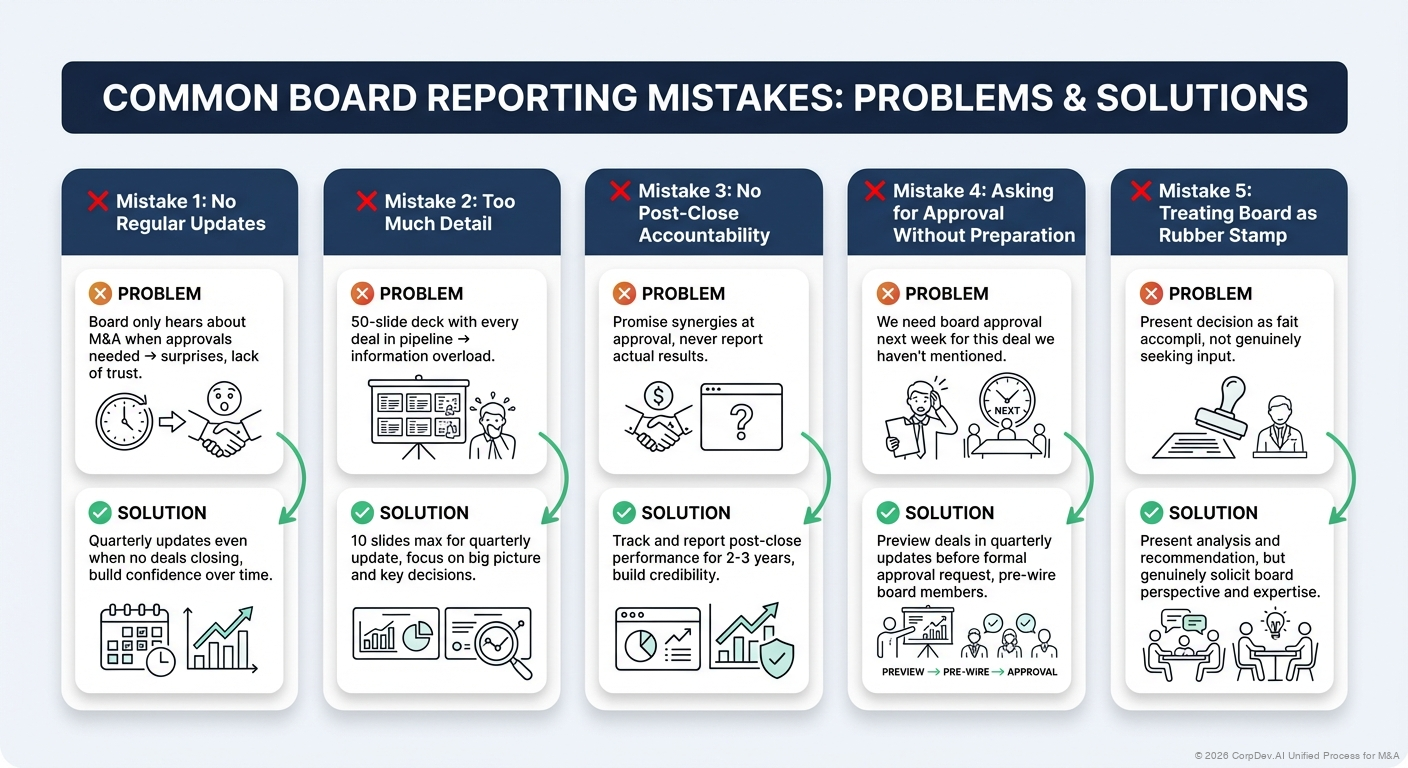
Common Board Reporting Mistakes

Common Board Reporting Mistakes - Visual Overview

❌ Mistake 1: No Regular Updates

Problem: Board only hears about M&A when approvals needed β†’ surprises, lack of trust

Solution: Quarterly updates even when no deals closing, build confidence over time

❌ Mistake 2: Too Much Detail

Problem: 50-slide deck with every deal in pipeline β†’ information overload

Solution: 10 slides max for quarterly update, focus on big picture and key decisions

❌ Mistake 3: No Post-Close Accountability

Problem: Promise synergies at approval, never report actual results

Solution: Track and report post-close performance for 2-3 years, build credibility

❌ Mistake 4: Asking for Approval Without Preparation

Problem: "We need board approval next week for this deal we haven't mentioned"

Solution: Preview deals in quarterly updates before formal approval request, pre-wire board members

❌ Mistake 5: Treating Board as Rubber Stamp

Problem: Present decision as fait accompli, not genuinely seeking input

Solution: Present analysis and recommendation, but genuinely solicit board perspective and expertise


Board Reporting Checklist

Quarterly Update Checklist

  • M&A strategy refresh (how M&A supports corporate objectives)
  • Pipeline summary (count, value, stage distribution)
  • Near-term pipeline highlights (deals likely to advance)
  • Recent transaction updates (integration status)
  • Post-close performance (synergy capture, returns vs. plan)
  • Market intelligence (competitive M&A, valuation trends)
  • Requests for board (guidance, introductions, upcoming approvals)
  • Materials sent 5-7 days before meeting
  • Presentation time: 30-60 min including Q&A

Deal Approval Checklist

  • Board memo (5-10 pages) sent 5-7 days before meeting
  • Full IC presentation deck with appendix
  • Financial model available for review
  • Diligence summary (key findings)
  • Clear recommendation (approve, price range, conditions)
  • Risk assessment and downside scenario
  • Financing plan and credit impact
  • Integration approach and timeline
  • Pre-wired with key board members
  • Presentation time: 60-90 min including Q&A

Key Takeaways

  1. Three types of board engagement - Quarterly updates, deal approvals, ad hoc updates
  2. Quarterly updates build trust - Regular cadence even without deals closing
  3. Balance transparency and confidentiality - Show pipeline metrics without naming targets
  4. Post-close accountability - Track and report synergy capture and returns vs. plan
  5. Respect board's time - 30-60 min quarterly, materials 5-7 days in advance
  6. Leverage board expertise - Ask for guidance, introductions, strategic input
  7. Be honest about challenges - Report integration issues and below-plan performance
  8. No surprises - Preview deals in quarterly updates before approval requests
  9. Clear asks - What decision or input do you need from board?
  10. Build credibility over time - Consistent reporting, deliver on promises, learn from mistakes
πŸ’‘ Remember
Board reporting is not a compliance exerciseβ€”it's an opportunity to build trust, leverage expertise, and secure support for your M&A program. Boards that are informed, engaged, and confident in management's M&A capabilities are more supportive when approvals are needed.

Related Resources

Last updated: Thu Oct 30 2025 20:00:00 GMT-0400 (Eastern Daylight Time)