
Digital Twins for Corporate Development
In corporate development, a digital twin is a linked model of how a business runs. It connects the customers, contracts, and sites of a business to the people, systems, and P&L lines that support them. Its value is tracing what a deal changes: when a parent's contract, system, or shared plant goes away at closing, the twin shows what depended on it.
Build it around one question: which dependencies must keep working for the business plan to hold, and which will change under new ownership? A twin that answers that question supports diligence, a carve-out perimeter, Day 1 readiness, and integration design. It is only as reliable as the evidence behind each link.
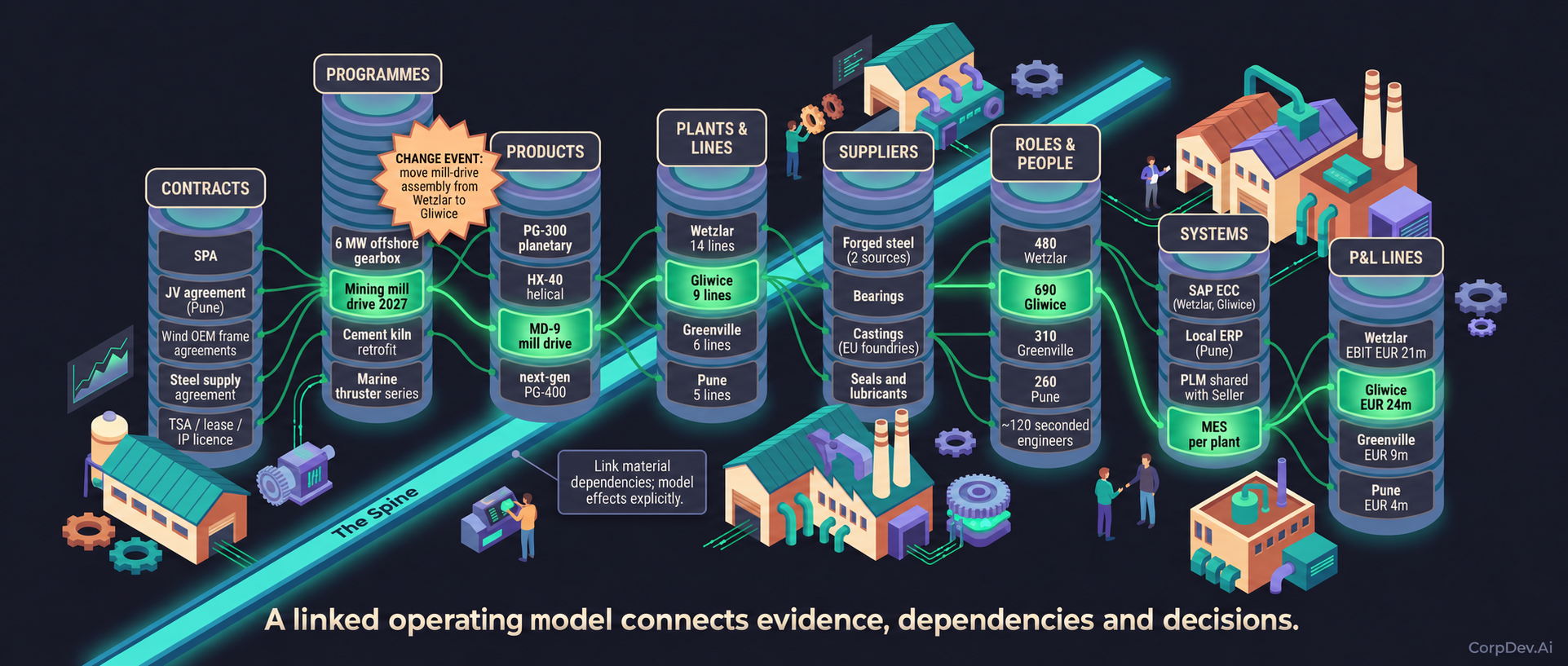 Contracts ↗Programs ↗Products ↗Plants and lines ↗Suppliers ↗Roles and people ↗Systems ↗Financial accounts ↗Share purchase agreement ↗Joint venture agreement ↗Customer framework agreements ↗Steel supply agreement ↗Transition services, lease and IP license ↗Offshore gearbox program ↗Mining mill drive program ↗Cement kiln retrofit ↗Marine thruster program ↗PG-300 planetary product ↗HX-40 helical product ↗MD-9 mill drive product ↗Next-generation product ↗Wetzlar plant capacity ↗Gliwice plant capacity ↗Greenville plant capacity ↗Pune plant capacity ↗Forged steel supply ↗Bearing supply ↗Casting supply ↗Seals and lubricants ↗Wetzlar people ↗Gliwice people ↗Greenville people ↗Pune people ↗Seconded engineers ↗Shared ERP ↗Local ERP ↗Product lifecycle management ↗Manufacturing execution systems ↗Wetzlar financial results ↗Gliwice financial results ↗Greenville financial results ↗Pune financial results ↗Trace the effects of a proposed assembly transfer ↗
Fictional industrial example. All names and figures are illustrative. Relationships identify dependencies; financial or operational consequences require explicit assumptions and validated calculations.
Text links for this illustration
- Contracts
- Programs
- Products
- Plants and lines
- Suppliers
- Roles and people
- Systems
- Financial accounts
- Share purchase agreement
- Joint venture agreement
- Customer framework agreements
- Steel supply agreement
- Transition services, lease and IP license
- Offshore gearbox program
- Mining mill drive program
- Cement kiln retrofit
- Marine thruster program
- PG-300 planetary product
- HX-40 helical product
- MD-9 mill drive product
- Next-generation product
- Wetzlar plant capacity
- Gliwice plant capacity
- Greenville plant capacity
- Pune plant capacity
- Forged steel supply
- Bearing supply
- Casting supply
- Seals and lubricants
- Wetzlar people
- Gliwice people
- Greenville people
- Pune people
- Seconded engineers
- Shared ERP
- Local ERP
- Product lifecycle management
- Manufacturing execution systems
- Wetzlar financial results
- Gliwice financial results
- Greenville financial results
- Pune financial results
- Trace the effects of a proposed assembly transfer
Start with the decision the model must support
Write a short brief before building anything. It should cover:
- The deal perimeter, and the businesses and periods in scope
- The decisions the model will support
- The evidence available
- The operating sponsors accountable for the model
Decide which relationships matter before modeling any process. Different deals put different dependencies first:
| Deal type | Dependencies to map first |
|---|---|
| Carve-out | Everything shared with the seller: contracts, people, technology, facilities, purchasing, funding, and services |
| Capability acquisition | Product, intellectual property, technical architecture, customer deployments, and key people |
| Consolidation | Production limits, customer commitments, duplicated resources, and costs that remain after the planned changes |
Write down what the model cannot yet answer. "Which products depend on a shared service?" is a tracing question. "What will losing that service cost?" needs added assumptions and a tested calculation.
Map the business as objects and the links between them
Give every object a stable identity. Keep a legal entity separate from a brand, a customer group separate from the entity that signs the contract, and a site separate from the work done there.
The table lists the objects most deal questions need, the links worth tracing, and where the evidence usually sits.
| Object | Relationships worth investigating | Evidence examples |
|---|---|---|
| Customer and contract | Buys products; requires service levels; has specific contracting parties | Agreements, amendments, order history, account records |
| Product or program | Uses components, production steps, rights, and supporting systems | Product master, bills of materials, process documentation |
| Plant and capacity | Makes particular products; depends on equipment, labor, and utilities | Site visits, production records, capacity assessments |
| Supplier and material | Supplies specified inputs under particular commercial terms | Supplier master, agreements, purchasing and quality records |
| People and roles | Run processes, hold knowledge, make decisions, support customers | Organization records, role descriptions, checked interviews |
| Systems and data | Support transactions, planning, engineering, reporting, and access | Architecture, interfaces, licenses, service ownership |
| Legal entity and owner | Holds assets, employs staff, signs agreements, provides shared services | Corporate records and specialist legal analysis |
| Financial accounts | Record revenue, costs, assets, liabilities, and cash effects | Ledger, management accounts, allocation schedules |
Each link should name the relationship, such as "made at," "supplied under," "supported by," or "recorded in." Record its source, the period it covers, and whether it has been checked. Appearing in the same document does not make two objects dependent.
Record the evidence behind every link, and the gaps
Keep the original documents and the page or cell behind each important fact. Note whether a link comes from a signed agreement, operating data, a management interview, a site visit, or an analyst's inference. Different sources can describe different periods or conditions, and both can be right.
When sources conflict, keep both and name who will resolve the conflict. A system inventory may list an application as retired while a production team still relies on it. Choosing the newer document makes the model look clean and hides the operating problem.
Track coverage as well as links: which sites, contracts, product families, and systems were reviewed, and which were not. An empty field means "unknown" until someone confirms there is no important dependency.
Tie the operating picture to the financial case
Link operating objects to the financial perimeter without pretending every ledger entry maps to one product or site. Show allocation rules and shared costs openly. Reconcile the mapped revenue and costs to the accounts, including any unexplained difference.
Capacity needs four separate numbers: installed capacity, practical capacity under stated conditions, actual output, and forecast demand. Product mix, shifts, yield, maintenance, and shared equipment all change the useful figure, so operations should confirm the assumptions. A drawing of a factory does not show what it can produce.
Finance turns proposed changes into the business case. A link can show an exposure without putting a cost on it. And removing a parent's allocated charge saves nothing if the business must buy a replacement service.
Keep current, Day 1, and target states separate
Maintain three dated views: the business today, the proposed Day 1 state, and the longer-term target. Each lists its assumptions and approval status. Record every difference as a change with an owner, a prerequisite, a cost estimate, and evidence of completion.
A dependency might continue on Day 1 under a transition services agreement (TSA), then move to the buyer's platform. Show it in all three states rather than deleting it once a replacement is proposed. A planned migration and one that has been tested and accepted are different states.
The integration lead owns the transition view, and functional owners confirm feasibility and readiness. Counsel assesses contract rights and obligations, and finance confirms the financial effects. CorpDev keeps each change tied to the investment thesis and the approval conditions.
Trace consequences in the twin; calculate them elsewhere
A linked model traces relationships and organizes scenario inputs. It does not simulate operations or prove cause and effect. Asked "What if this plant closes?", it first lists the products, contracts, people, systems, and costs that may be affected.
Estimating the effect on output or cash flow needs explicit assumptions about transferability, capacity, customer behavior, timing, and replacement costs. Use the right engineering, operating, or financial model, confirmed by its owner, and show sensitivities and open inputs rather than one precise result.
Keep observed facts, proposed changes, and calculated consequences visibly separate. Being able to draw a connection does not prove the consequence will happen.
Worked example: a fictional gearbox carve-out
Consider a fictional gearbox manufacturer being carved out of its parent. Its customer contracts depend on production at Plant A, heat treatment supplied by the parent, and a scheduling system the parent hosts. The illustrated industrial example on CorpDev.Ai's digital twins page shows this type of connected view; it is an illustration, not evidence about an actual company.
Installed capacity is 60,000 units a year. Operations confirms practical capacity of 44,000 for the forecast product mix and stated shifts. The buyer's forecast needs 50,000. On those assumptions, the model shows a gap of 6,000 units. It does not show whether another shift, plant, or supplier can close it.
The team traces the affected customer programs and investigates added equipment, labor, heat-treatment access, scheduling support, and customer requirements. Counsel assesses the contracts, operations evaluates the alternatives, and finance costs the feasible options. Day 1 planning keeps the parent's services in place until replacements are proven. The investment case changes when the team has evidence for a response it can carry out.
These figures are fictional scenario inputs, not capacity benchmarks or claims about savings.
Trace one Day 1 change through every link
The expensive surprises in a carve-out tend to be dependencies nobody wrote down. Suppose the parent's steel supply agreement ends at closing. Which customer programs, plant lines, contracts, and cost lines depend on it? A twin makes the trace possible, but someone must walk every link outward and read the document behind each one. An AI model can do that walk: it proposes links from permitted documents, matches identities, and flags records that disagree. The discipline is keeping its proposals apart from what the team has confirmed.
A hypothetical excerpt, continuing the fictional gearbox case:
| Affected item | Chain of links | Evidence | Status |
|---|---|---|---|
| Plant A, line 2 | Supply agreement → alloy steel grade → Plant A line 2 | Supply agreement, schedule 1, p. 9; line 2 routing sheet | Confirmed |
| Customer B wind program | Plant A line 2 → gearbox model G7 → Customer B contract | Customer B contract, exhibit A, p. 3 | Confirmed |
| Cost of goods sold, gear segment | Steel price under parent terms → segment standard cost | Management accounts, note 4 | Confirmed |
| Customer D spare-parts orders | G7 spares → probably the same steel grade | Order history only; no bill of materials in the room | Inferred |
The confirmed items go into the Day 1 plan with owners: a replacement supply contract, an interim TSA, or a cost change in the business case. The inferred items become diligence requests. A link stays inferred until a specialist has read the document behind it. The relevant specialist signs off any link that affects customer obligations, capacity, financial assumptions, or the deal perimeter.
Protect the results as carefully as the sources. A trace can combine facts that are each restricted into something more sensitive. AI in M&A sets out how deal teams handle those rules.
In CorpDev.Ai
A digital twin links sites, contracts, customers, people, systems, and P&L lines, with diligence findings pinned where they apply and Day 1 drawn against the target state. The team develops it from the evidence in AI Room. It is an information model for tracing questions like this one, not a simulation.
Hand over a model record the next team can maintain
Use a record structure that lets anyone inspect and update the model:
Object ID / type / name / legal or operating perimeter
Relationship ID / source object / relationship / destination object
State: current / Day 1 proposal / approved target / completed
Effective date or period / source version and evidence location
Status: verified / reported / inferred / disputed / unknown
Business owner / validating specialist / validation date
Linked account or model input / units / allocation rule
Dependency / proposed change / prerequisite / action owner
Open question / decision consequence / next review trigger
Hand over the source register, linked model, coverage gaps, financial reconciliation, state comparison, and decision log together. The receiving operating team should accept ownership of open dependencies and future updates. A twin stays useful only while source changes and completed actions keep flowing into it. A diagram nobody updates is a picture, not a twin.
Continue with due diligence, post-merger integration, and value creation planning.
© 2026 CorpDev.Ai Unified Process for M&A